


Awareness drive on CLIMATE CHANGE, ENERGY SWARAJ with Prof. Chetan Singh Solanki
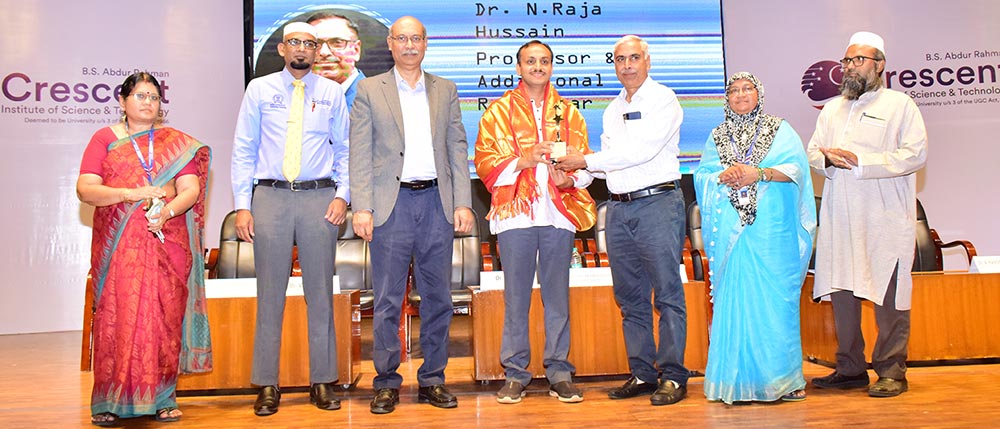
Prof. Chetan Singh Solanki, Professor at IIT, Bombay visited B.S.Abdur Rahman Crescent Institute of Science and Technology Campus, Chennai on his 11-year-long Yatra on 18.04.22 and conducted a workshop on “CLIMATE CHANGE, ENERGY SWARAJ AND I”.
In the context of Energy Access, Energy Sustainability and Climate Change, Prof. Chetan S Solanki have coined the term Energy Swaraj . He works in establishing Energy Swaraj or providing localised solar energy solutions across the globe by developing solar PV technologies and products, developing and conducting training on solar PV technologies and products, planning and executing large scale projects, particularly in the off-grid energy sector, monitoring the impact and conducting research. He is also interacting with policy makers and providing inputs in policy making. He has been recently conferred with the title of Brand Ambassador of Solar Energy for Govt. of Madhya Pradesh.
During his yatra, which began in November 2020 from Mumbai, he has been creating a public movement towards 100% adoption of solar energy. The ‘solar bus’ reached Chennai after covering 18,000 km across nine states. Prof. Solanki’s ‘mobile home’ is equipped with 3.2 kW solar panels and 6 kWh of battery storage. It also has a 3 kVA inverter. The bus runs on diesel, but all lights, cooler, cookstove, and other appliances inside it are solar-powered.
For switching fully to solar energy, Prof. Solanki advises a three-step approach—’Avoid, Minimise and Generate’. “Avoid use of energy as much as possible even if it is solar energy. If you can’t avoid the use of energy, minimise its use through use of efficient appliances. And, generate energy locally. Energy Swaraj is about distributed production, and its Energy by Locals for Locals” he said. Prof. Solanki undertook the Energy Swaraj Yatra after an international trip convinced him that very little was being done constructively to mitigate global warming. But for ‘Energy Swaraj’ to succeed, government action alone would not suffice, he said. Underscoring the importance of energy literacy, he said individuals and institutions would have vital roles in it.